There are several different methods of recording, and it depends on whether you want to just note the occasional butterfly or moth that you see, or you want to go out looking for and recording them on a regular basis. We welcome all sightings, and we need to know about the common species as well as the rarer ones.
Casual recording
This is an easy way to report butterflies that you see anywhere and everywhere in the course of daily life. You can choose any of the following methods to report your sightings to us.
* Use our Excel spreadsheet on your computer. You can download this from HERE or alternatively request this using our contact form.
* Use an app. on your smartphone such as iRecord Butterflies (see below). Download this free using iTunes or the Google Play Store.
* Email your butterfly sightings to records@cornwall-butterfly-conservation.org.uk. Make sure you provide a date, location and grid reference for each species seen and also the number seen.
* If you prefer using a piece of paper, download our casual record sheet and print it out. Send us a photocopy, ensuring that we can read your writing, or alternatively transcribe your records using one of the above options.
Garden butterfly recording
For butterflies you see in your garden, you can report these using the Garden Butterfly Survey website and follow the simple guidelines.
Butterfly transect walking
Transects involve walking a pre-defined route on a weekly basis so that all of the butterfly species that emerge throughout the year can be recorded. The sightings from transect walks are entered into a national database organised by the UK Butterfly Monitoring Scheme. We need lots of people to help, all over the county. You can set up a new transect near your home or alternatively take on a vacant transect or join a team of walkers for a particular transect. We have a friendly team to help, and we can provide training to help your identification skills.
If you are interested in becoming a transect walker, please contact Kelly Uren at transect@cornwall-butterfly-conservation.org.uk.
Wider Countryside Butterfly Survey (WCBS)
This is a national survey run by a broad partnership of organisations, which aims to reach ordinary parts of the countryside not covered by transect walks. This is intended to give a more accurate picture as to how butterflies are doing, as the transect walks tend to exist to record the rarer species or special habitats. The WCBS was started in 2009 and runs as a partnership between Butterfly Conservation (BC), the British Trust for Ornithology (BTO), the Centre for Ecology and Hydrology (CEH) the Joint Nature Conservation Committee (JNCC), and supported and steered by Forestry Commission, Natural England, Natural Resources Wales, Northern Ireland Environment Agency, and Scottish Natural Heritage. Participants include recorders from the BTO/JNCC/RSPB Breeding Bird Survey (BBS) and BC's volunteer network. There are set areas to be monitored at least two times a year, in July and August.
If you are interested, please contact Kelly Uren at transect@cornwall-butterfly-conservation.org.uk.
Moth records
A lot of moths and caterpillars are visible during the day so can be seen without any specialist equipment. Night flying moths are a bit more difficult. Moths are attracted to light, so outside lights or purpose built 'moth traps' are very useful for recorders. Most purpose built 'moth traps' do not harm the moths and they can be released after identification. Any moth species that you see and can identify, can be recorded and submitted to the County Moth Recorder. Sightings of life cycle stages, such as eggs or caterpillars, are just as welcome as records of adult moths.
Step 1: spot and identify your moth.
Step 2: write down the essential details to make a record (species, date, number seen, location name and grid reference).
Step 3: submit the record. Please send only Cornish moth records to Leon Truscott, our Cornish County Moth Recorder by email at leon.truscott47@gmail.com
Please ensure each record includes the following information:
*Your full name and contact details
*Record date
*Common and scientific name of moth
*Location and grid ref
*Quantity
*Sex if known
*Survey method used
*Any other comments
Even without a signal you will still be able to record the butterflies you see.
Records can help to establish the distribution and size of populations, and regular recording may enable us to detect changes over time.
The iRecord app is so easy to use you will be able to record your sighting with just a few clicks.
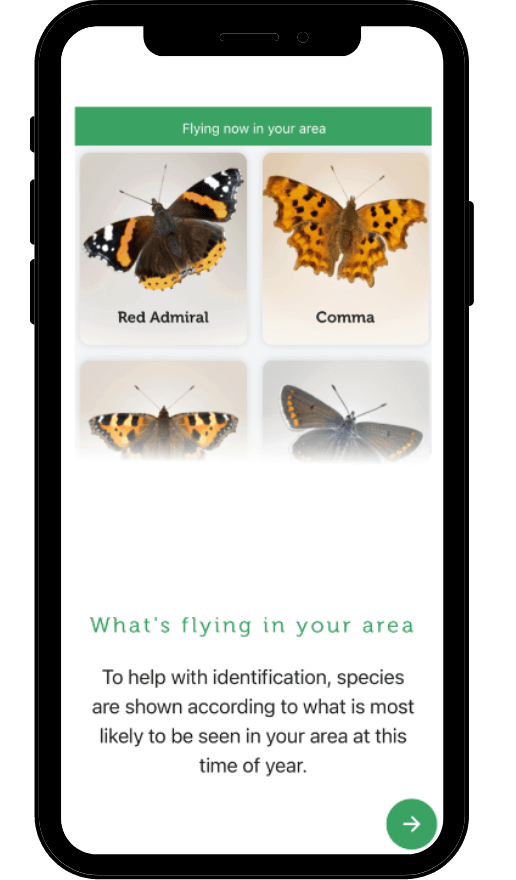
Contribute your species sightings with GPS acquired coordinates.
Automatic checks will be applied to your observations to help spot potential errors, and experts can review your sightings.
Let other butterfly and conservation enthusiasts see your sightings.

Every penny counts if you would like to donate to the Cornwall Branch then please click below.
Spotted a butterfly but not sure what it is? Our handy identification section will help you find out.


